

HC9 presents an interview series with portfolio company leaders. We’re interested in how they are solving health care’s biggest problems, what drove them to start a company, and why they chose to work with HC9.
Richard Lungen (HC9)
Mike, I’ve known you for a long time, but I’m interested in the founding of Optura. Knowing your story, how did you meet Andy? What brought the two of you to decide to found a company together? What was happening in both of your minds around that time?
Mike Hollis (Optura)
Andy was my customer at Cigna. Prior to this role, I led all revenue and commercial functions at a company called E-Mids, a health tech services company of around $200 million. Cigna was consistently our second, third, or fourth biggest account for six or seven years.
Andy was an IT executive there who eventually became the Chief AI Officer, and he also owned all automation. I knew him as a client and had a great relationship with him from that perspective. We’d occasionally talk about bigger macro topics related to AI and what was happening in the movement.
He had started exploring, with a few other tech execs at Cigna, whether they could stand up a software division or something unique. His boss ultimately said, “I don’t think we can stand this up quickly enough to take advantage of the moment AI is having right now. You should go do it on your own.”
Around that same time, my son—who has a rare condition—regressed twice in early 2024, in February and again in June/July. It reached a point where I couldn’t operate or travel to keep up with the demands of my position. Our investors were incredibly kind and allowed me to shift into an advisor role.
About the same time, Andy said, “I’m thinking about this new company or idea—what do you think?” And I said, “Let me help you.” I’d already been getting inbound requests in my commercial role related to AI—things E-Mids didn’t do—helping people navigate the complexity of AI adoption.
We spent Q4 of 2024 talking about the business: do we de novo create something? We were also approached by a few private equity groups about rolling up companies to create a more mature entity. We investigated that deeply and ultimately felt we both were at points in our careers where we didn’t want to be backed by private equity.
We wanted control of culture, of the tech narrative, and the ability to define our own timeline—especially because he has kids and I may need to go to a doctor’s visit for my son. We wanted the ability to pause when life required it.
So he said, “Let’s have a couple of old fashioneds,” and on Christmas Eve we decided to start the business. We didn’t even have a name yet. We LLC’d it on Christmas Eve so we could win a contract by 12/30—because if we didn’t, we would have lost it. We did win it, and January 1st we were off to the races.
We went to JPMorgan and realized we had something truly special. We won Prom Therapeutics as our alpha customer, and since then we’ve won six other customers and are talking to about half of the major companies in healthcare. It’s exciting.
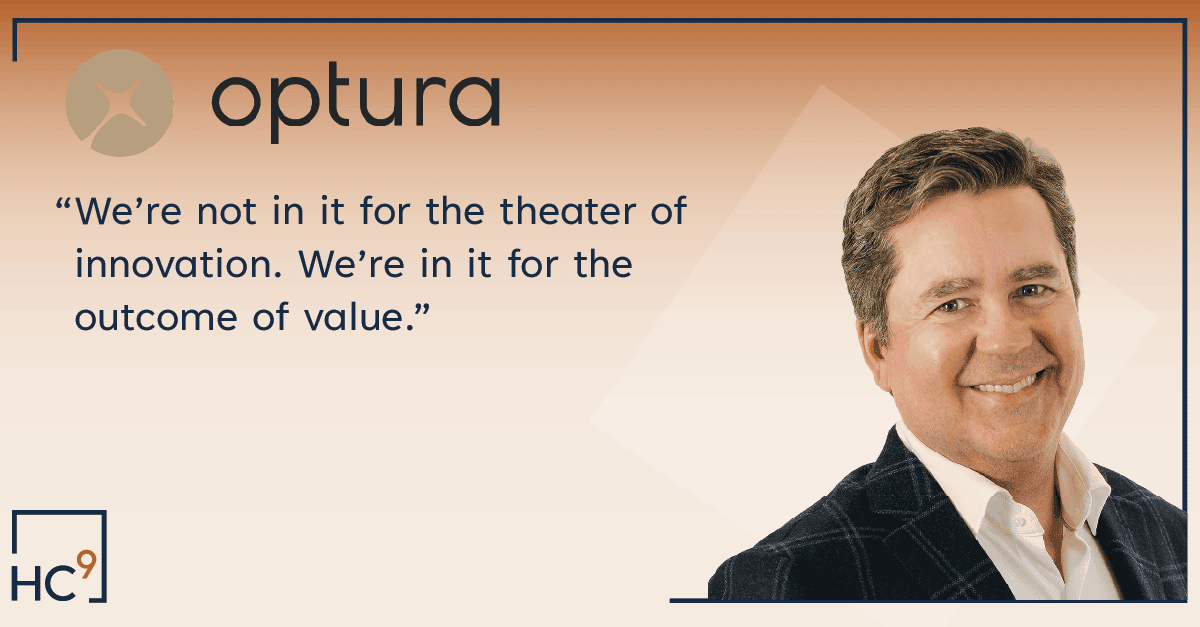
All of it is rooted in values. Andy and I both grew up in blue-collar environments where people value a day of hard work and output. We’re not in it for the theater of innovation—we’re in it for the outcome of value. That’s why we trademarked ROAI.
We don’t look at theory. We look at whether AI actually generates value for the enterprise, and more importantly, for healthcare. Our unique goal—at the end of this—is to move the GDP needle by 1%. If healthcare makes up 20% of GDP, and we can help automate or improve behaviors through AI, that’s a meaningful improvement for everyone.
Richard Lungen (HC9)
You talked about the trends you’d been seeing and what brought you together. What were the gaps that Optura was created to solve? Tell us about the product itself.
Mike Hollis (Optura)
I call it the four Ps. First: the power of AI. When OpenAI launched commercially in Q4 2023, everyone started experimenting and believed AI could move the needle in healthcare.
Then came pilots—people playing around with use cases and trying to introduce AI into the enterprise.
Now we’re seeing point solutions—very narrow offerings being sold into healthcare—which has created a state of paralysis. You have power, pilots, and point solutions, but none of it is indexed to value. There’s no North Star.
Every CFO, CEO, and CIO we talk to says the same thing: this combination has created paralysis. They can’t see through the noise. They don’t know what’s signal versus noise, and they often don’t know what the enterprise can metabolically absorb. They need support.
Our platform gives them that support—power, accountability, responsibility, and the possibility of bringing everything together. That was the gap. If someone could help organizations carry the compass and get AI working across the enterprise, there would be enormous opportunity.
Richard Lungen (HC9)
From a market standpoint, do you even have competitors? How do you see yourselves fitting in?
Mike Hollis (Optura)
It’s a Venn diagram.
There are theorists—big consulting companies providing ideas about what’s possible. But often we inherit a 200-page PowerPoint deck created two or three quarters ago that no one has moved on.
Then there are point solutions and platforms—very narrow tools solving specific problems like prior auth or ambient documentation. They don’t interconnect with broader ecosystems or legacy tech, so they stay siloed, which limits value.
Then you have traditional tech services players—firms that want to build everything. Very generative shops. Lots of dev and engineering.
Our belief is that proximity to the problem matters most. We want to sit close to the C-suite, understand the real enterprise problems, and solve those with AI—without adding new problems.
And if we do it right, it becomes a flywheel: solve bigger problems, create bigger impact, and accelerate organizational metabolism and behavior change.
Richard Lungen (HC9)
What kind of feedback are you getting from customers? What are your best use cases so far?
Mike Hollis (Optura)
The biggest thing is that we’re the first company to walk in with a compass and a map, and then execute on the art of the possible.
We are the only company talking about value out of the gate. It’s not about tech. It’s: What does the organization need to do to create value for shareholders, stakeholders, patients, members?
Value means different things depending on the organization. It could be profitability, patient experience, clinician delight—it can even change quarter to quarter.
We always start with the North Star value. Once that’s clear, the platform democratizes the process. You can crowdsource ideas against those values, and the platform surfaces where AI can make an impact. As we introduce AI, we score and capture ROAI back into the P&L. That’s truly unique.
Richard Lungen (HC9)
Talk a little more about ROAI.
Mike Hollis (Optura)
Well, it looks great on a hat—I’ll start there.
But seriously, it’s the ethos and mission of the company. ROAI isn’t just about putting numbers back into the P&L. It comes back to the value of the enterprise and what the leadership team is trying to achieve.
All the AI effort in the world is empty calories if it’s not aligned to what matters. ROAI is the category that brings that alignment to life.
We believe AI adoption and AI metabolism are built around ROAI. If you can prove something works and scale it, you build trust. And with trust, you can transform the business. The more it works, the more organizations are willing to change—metabolically and behaviorally.
It’s absolutely the ethos of the company.
Richard Lungen (HC9)
What’s ahead for Optura in 2026? Product roadmap? Growth direction?
Mike Hollis (Optura)
Tongue-in-cheek: by JPMorgan 2027, I want Optura to be the gold standard by which AI is measured in healthcare—across all segments. The company CEOs, CFOs, and CIOs call when they have questions about navigating AI.
We’ll segment the business to serve payers, providers, and some life sciences by the end of the year. We’ll have a robust IP catalog—our onagentic catalog—for those segments, including a first-of-its-kind planned offering called the Generator.
The Generator enables self-generative agent builds. You can literally type an idea into the platform, and because of the way we’ve configured and interconnected it, an agent can be generated at 80–90% fidelity. We just customize the last 10%.
That shifts productivity cycles from 8–12 weeks to 2–3 days. It’s self-generative—the more it does, the more it learns, the more feedback it provides.
If we do it right, it can dramatically bend the administrative cost curve in healthcare. It’s very cool.
Richard Lungen (HC9)
Yeah, it’s awesome.
Mike Hollis (Optura)
It’s wicked cool.
Richard Lungen (HC9)
Two to three days—that’s incredible.
Mike Hollis (Optura)
Yeah. Someone compared us to the fixer from Pulp Fiction. We don’t clean up dead bodies, but we fix things. The Wolf—that’s his name.
Richard Lungen (HC9)
Last question. Why HC9?
Mike Hollis (Optura)
Financially, it’s a terrible decision—I’m selling my equity to myself at a discount.
But it’s the right thing for the company. I know the value of HC9. I know the LP community. HC9 can lift the business, and suddenly we have 150+ megaphone holders saying good things about what we’re doing for healthcare.
That’s important—for the business and for healthcare. I’m happy to be part of the HC9 family.
Richard Lungen (HC9)
We’re a megaphone helping you scale even faster—getting that messaging out is key.
Mike Hollis (Optura)
Optura is about putting AI to work—getting value. It’s not about theater. People in healthcare, especially in the C-suite, are fatigued. There’s so much noise.
We don’t want people heading into an AI winter because they’re frozen and unsure what to do. The art of the possible is there—they just have to lean in.
About Optura:
Optura is healthcare’s AI orchestration platform designed to turn disconnected pilots into a unified, enterprise-scale AI program that delivers measurable value — fast.
For more information visit optura.ai.